The Aggregate Is the Skeleton Page of a Society
AKA The Layer Cake

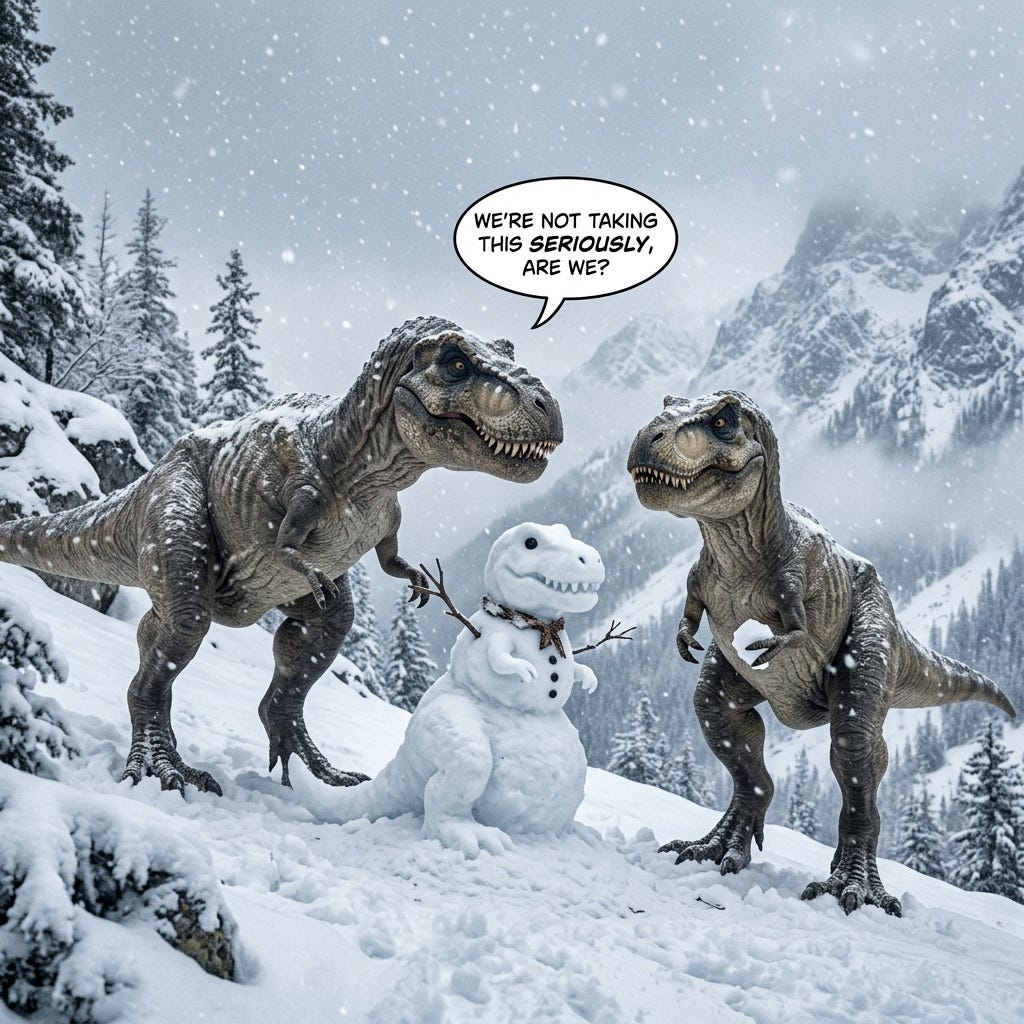
-image courtesy of Nano Banana 2
(from a 1980’s cartoon I recall reading but have no knowledge of the artist.)
What the AI Jobs Debate Gets Wrong
— and Why Both Sides Are Reading the Same Wrong Instrument
Stephen Klein’s recent piece on the AI jobs debate is worth reading. The financing-not-productivity argument is correct and the arithmetic supports it.
Meta’s 2026 capex guidance is $125–145 billion — double its 2025 spend.
Meta’s entire human compensation bill is approximately $27 billion.
The AI infrastructure budget is four to five times the entire payroll.
Mark Zuckerberg said it plainly in a town hall to his own employees: “Getting everyone internally to use AI tools and getting to do the work more efficiently is not the thing that’s driving layoffs.”
The cuts are not productivity-driven.
They are financing-driven.
The headcount reductions are paying for the GPUs.
Klein’s reading of the Altman sequence is also clean. Jobs are definitely going to go away, full stop (2023). Entire classes of jobs will go away (2025). Jobs doomerism is likely long-term wrong (2026).
Three years.
Three positions.
Klein’s diagnosis: the data didn’t move him. The politics did. The narrative tracked the interest, not the evidence.
This is correct. The story doesn’t end there.
The Yale Budget Lab Finding
The Yale Budget Lab has been tracking employment effects in real time. Their analysis of BLS Current Population Survey data through December 2025 finds stability, not major disruption at an economy-wide level.
Executive Director Martha Gimbel: “No matter which way you look at the data, at this exact moment, it just doesn’t seem like there’s major macroeconomic effects here.”
Klein takes this as proof. “There is no AI job apocalypse. There never was one. There likely won’t be one anytime soon.”
This is a bit stronger than the evidence supports.
Gimbel’s own hedge — “at this exact moment” — is doing work Klein’s headline drops. No major macroeconomic effect at this exact moment is not the same claim as there never was and won’t be one. But more fundamentally: the question Klein and the AI executives are both arguing — is there an aggregate macroeconomic disruption — is the wrong question.
It dissolves the real argument by asking it in the wrong unit.
Transitional Apocalypses Do Not Show Up in Aggregate Data
They show up in distribution.
The aggregate can read as stability while specific populations are destroyed, because the aggregate sums the destruction of some against the gains of others and reports the net as calm.
The enclosure of the English commons did not register as an apocalypse in national output — output rose. It registered as the destruction of a way of life for the rural poor who lost access to the land, while the landowners who enclosed it captured the gain. he mechanisation of weaving did not show up as a macroeconomic disruption — textile production soared. It showed up as the Luddites, handweavers whose specific skilled livelihood was destroyed while mill owners and consumers captured the surplus.
The Highland Clearances were an apocalypse for the cleared and a portfolio optimisation for the landlords.
In each case the aggregate data would have read, in Gimbel’s phrase, as no major macroeconomic effect at this exact moment — because the effect was not macroeconomic.
It was distributional.
And it fell on people whose destruction the aggregate was structurally unable to see.
The Skeleton Page of a Society
This is the Skeleton Page operating at the scale of an entire economy.
The macroeconomic aggregate is the skeleton page of a society. It records output, employment totals, GDP — the bones. It cannot see which specific networks were dismantled to produce the totals, whose institutional knowledge was discarded, which communities were hollowed, because the aggregate nets the losses against the gains and reports only the sum.
A transitional apocalypse is precisely a case where the circulatory system of a particular population is drained while the skeleton page of the whole economy stays green. The destruction is real. It is invisible to the instrument measuring it — for the same structural reason connection capital is invisible to GAAP: the instrument was built to measure the aggregate, and the aggregate is where the distribution disappears.
Klein is reading the macroeconomic skeleton page and concluding there was never an apocalypse. The AI executives read the same skeleton page — in the window when the fear inflated the valuation — and concluded one was inevitable.
Both are disputing what a single instrument shows.
Neither is asking what the instrument cannot see.
Bill’s Law
The reason transitional apocalypses so rarely touch the wealthy is the reason the Connection Dynamics framework keeps returning to: the people who decide which transitions happen, on what timeline, with what transition support, are not the people the transition destroys.
Enclosure was decided by those who gained from it.
Mechanisation was financed by those who captured its surplus.
The AI capex bet is being made by executives whose compensation tracks the share price the bet inflates, financed by liquidating the payroll of workers whose interests are not structurally weighted in the decision.
Bill’s Law states that the probability a network’s coordinated action achieves its intended outcomes is proportional to the fraction of network nodes whose interests are structurally weighted in the decision-making.
The inverse also holds.
A transition decided by the fraction that gains from it will fall on the fraction whose interests were not weighted. This is not an ethical statement. It is a structural observation about what transitions do when the people who authorise them are insulated from their costs. “No major macroeconomic effect” is what a transitional apocalypse looks like from the only vantage point that gets to name it — the vantage point of the people it doesn’t touch.
The aggregate stays calm because their gains fill the hole left by the others’ losses.
What Klein Gets Right, and What the Framework Adds
The financing diagnosis stands. Connection capital is being converted into capex. The workforce — its institutional knowledge, its routing tables, its accumulated trust — is being liquidated to fund GPU purchases, and the liquidation is recorded on the skeleton page as a margin improvement that makes room for the capital expenditure. The 24/7 Wall St. line Klein quotes — layoffs are the financing — is the externalisation engine’s first layer stated in accounting terms.
The temporal structure is what Klein doesn’t have. The layoffs improve the skeleton page now.
The capex bet either pays off or doesn’t over a multi-year horizon.
If it doesn’t, the discharge arrives years later, attributed to whatever external condition coincides with it. The executives who ran the extraction-to-finance-the-bet will have captured their compensation before the bill arrives. This is Boeing’s structure with GPUs instead of buybacks.
But the headline claim overreaches. Klein wins the argument against the inflated apocalypse narrative and then over-claims in the opposite direction, asserting a negative he hasn’t established — and the no-apocalypse claim happens to align with what he is selling as CEO of an AI company. The financing argument survives the conflict of interest because it is grounded in public figures and Zuckerberg’s own words. The there never was one claim is where the interest and the conclusion converge suspiciously. Apply to Klein the same reading Klein applies to Altman.
Not as an accusation - as an objective analytic stance.
The question is not whether the aggregate shows disruption.
The question is whose specific network is being dismantled to finance the bet, and whether their interests were weighted in the decision that dismantles them.
The answer to the first half is in the Q1 2026 layoff figures: 81,747 jobs.
Named, counted, specific.
The answer to the second half is no.
That is a transitional apocalypse by the only definition that has ever applied — distributional, falling on those without standing in the decision — and it is fully compatible with the aggregate reading stability, because every historical transitional apocalypse was.
References
Klein, Stephen. “There Is No AI Job Apocalypse.” LinkedIn, May 2026.
Yale Budget Lab. Analysis of BLS Current Population Survey data, December 2025. executivedirector.yalebudgetlab.org.
Zuckerberg, Mark. Meta internal town hall, reported May 2026.
24/7 Wall St. “Layoffs Are Not the Cost-Cutting Story Here. Layoffs Are the Financing.” May 2026.
Connection Dynamics is free and not paywalled and it never will be. If it’s worth something to you, a paid subscription is a clear message even I can read. If you genuinely can’t afford it, read it anyway — I’d rather have your attention than your money any day.